Lupitor raises $5M in additional funding

Lupitor raises $5M in additional funding

Industries

Industries

Banking

Banking

Every call on the record. Including the difficult ones.

Every call on the record. Including the difficult ones.

Every call on the record. Including the difficult ones.

Collections, disputes, verification and servicing — resolved end to end, with the identity check, the wording and the action logged in a form your regulator accepts.

Collections, disputes, verification and servicing — resolved end to end, with the identity check, the wording and the action logged in a form your regulator accepts.

70%+ of calls contained end to end

100+ concurrent lines, fully on-prem

20% higher CSAT than human agents

70%+ of calls contained end to end

Collections

Disputes

Verification

“We could not put a voice agent in front of a collections book on a promise. We needed to see the wording rules enforced in the transcript, and we needed it inside our own estate. That is what got it through risk.”

Head of Customer Operations, top-five European banking group

70%+

of calls resolved end to end

100+

concurrent lines, fully on-premise

3 weeks

from kickoff to live

USE CASES

Start where the volume hurts.

Four lines banks put live first — each one a full workflow, not a deflection script.

Collections

Disputes

Verification

Servicing

Collections that stay inside the wording rules.

Only figures it can source. Only plans inside the policy band. A hardship signal ends the call and hands it to a person with the context already written up.

Outbound at your licensed concurrency

Hardship language routes to a human mid-call

Every promise-to-pay written back to core

The dispute is filed while the caller is still on the line.

The caller is verified, the transaction read back from core, the dispute classified against your scheme rules and the case opened in your system. No callback promised.

Transaction read from core, never from memory

Provisional-credit rules applied per card product

Case reference spoken before the call ends

Verification that survives review.

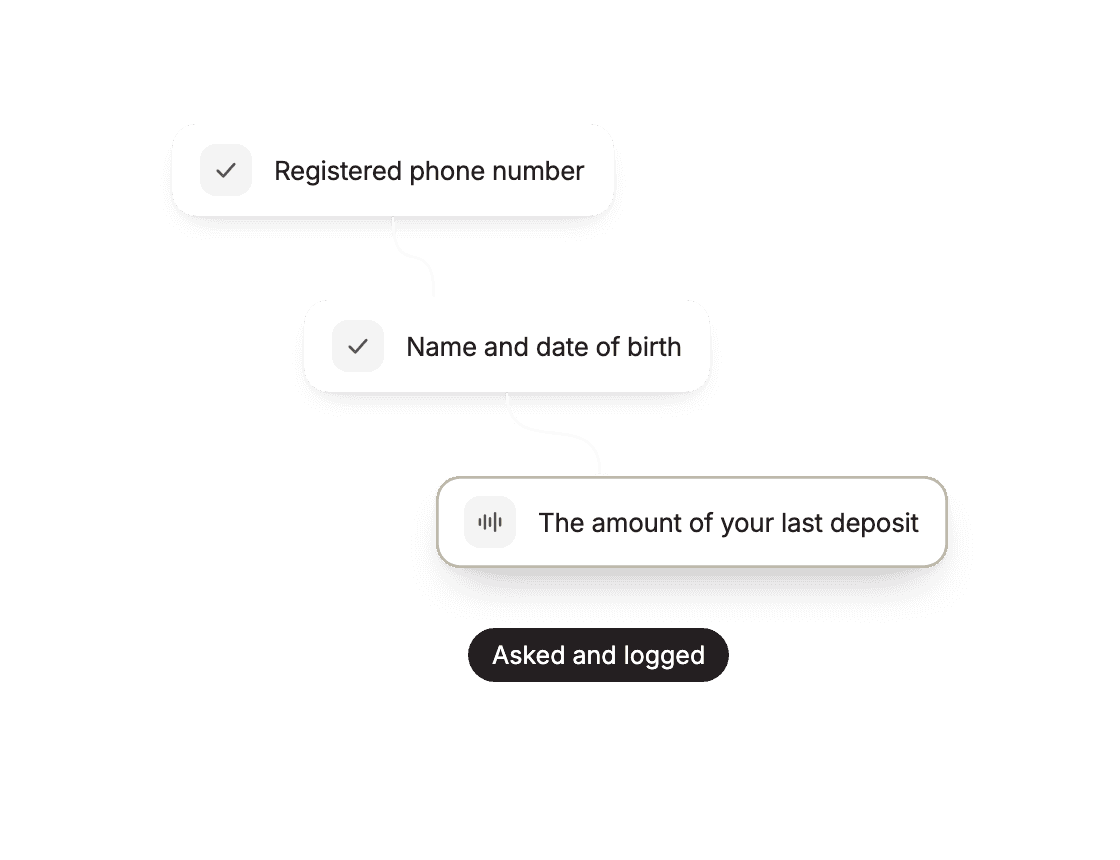
Callers are matched against your source of truth before anything moves. Thin records fall back to the questions your policy defines — and the agent logs which ones it asked.

Step-up rules per product and per amount

Failed verification ends the call and files the reason

Word-level transcript held against the case

Servicing that closes the request, not the ticket.

Balance, statement, limit change, address update, card reissue — read from core, actioned under permission, confirmed back to the caller before the call ends.

Read, file, offer, waive, close — each gated per line

Thresholds you set, enforced in-session

Confirmation number spoken and logged

Collections

Disputes

Verification

Servicing

Collections that stay inside the wording rules.

Only figures it can source. Only plans inside the policy band. A hardship signal ends the call and hands it to a person with the context already written up.

Outbound at your licensed concurrency

Hardship language routes to a human mid-call

Every promise-to-pay written back to core

The dispute is filed while the caller is still on the line.

The caller is verified, the transaction read back from core, the dispute classified against your scheme rules and the case opened in your system. No callback promised.

Transaction read from core, never from memory

Provisional-credit rules applied per card product

Case reference spoken before the call ends

Verification that survives review.

Callers are matched against your source of truth before anything moves. Thin records fall back to the questions your policy defines — and the agent logs which ones it asked.

Step-up rules per product and per amount

Failed verification ends the call and files the reason

Word-level transcript held against the case

Servicing that closes the request, not the ticket.

Balance, statement, limit change, address update, card reissue — read from core, actioned under permission, confirmed back to the caller before the call ends.

Read, file, offer, waive, close — each gated per line

Thresholds you set, enforced in-session

Confirmation number spoken and logged

REVIEW

Four things your risk committee will ask about.

1

1

Identity before anything moves

Callers are matched against your source of truth, with the knowledge-based fallback your policy defines. Nothing is read out or actioned before that passes.

2

2

Actions bounded by permission

Read, file, offer, waive, close — each one allowed, gated or blocked per line, with the thresholds you set.

3

3

Inside your jurisdiction

In-country cloud or air-gapped on-prem, with the same models and the same latency as our managed service. Your infrastructure changes. The platform does not.

4

4

An audit trail they can read

Word-level transcript, every tool call, every verification decision — exported in the format review already uses.